
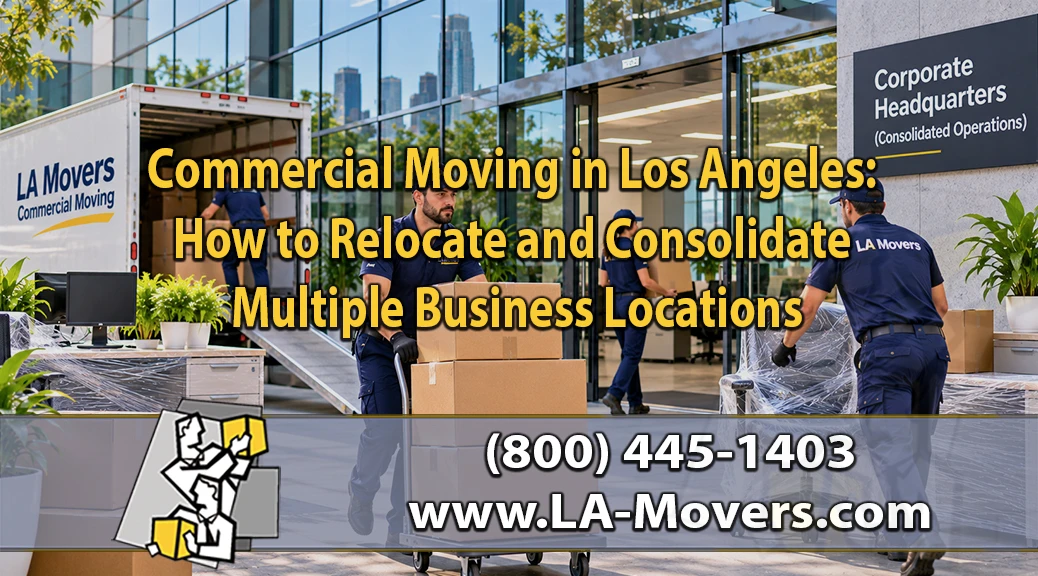
Businesses sometimes reach a point where operating from several locations no longer makes practical or financial sense. A company may have separate offices, storage facilities, administrative departments, or operational sites that it wants to bring together under one roof.
This type of relocation involves more than moving furniture from one address to another. It requires coordinating belongings from multiple properties, deciding what should be transferred, managing different building access arrangements, and preparing the destination to receive everything.
For businesses planning commercial moving in Los Angeles, these responsibilities can become particularly challenging when locations are spread across different neighborhoods or surrounding cities. Each property may have different operating hours, loading facilities, parking arrangements, and access restrictions.
A well-organized consolidation plan helps businesses understand what needs to move, when each location should be cleared, and how the new facility will be organized.
This article explores the practical considerations involved in relocating multiple business locations into a single commercial property and how professional movers can support the physical relocation.
Why Businesses Consolidate Multiple Locations
Business consolidation can happen for several reasons. A company may be expanding its main facility, reducing property expenses, reorganizing departments, or changing the way its employees and equipment are distributed.
Some businesses operate from multiple offices because they have grown gradually over time. Others maintain separate storage areas, administrative offices, showrooms, or operational facilities that eventually become less convenient to manage.
Bringing these locations together can create opportunities to improve how the business uses its space.
Reducing the Complexity of Multiple Facilities
Managing several properties can involve separate leases, utilities, maintenance responsibilities, access arrangements, and operating costs.
Consolidating locations may reduce some of these administrative responsibilities. It can also make it easier for management to coordinate employees, equipment, and shared resources.
However, the physical relocation needs to be organized carefully so the benefits of consolidation are not undermined by confusion during the move.
Bringing Departments Closer Together
Businesses with separate departments may decide to bring their teams into a shared facility to improve communication and coordination.
For example, administrative employees, sales teams, operations staff, and management may previously have worked from different locations. A consolidated property can provide dedicated areas for each department while allowing teams to work within the same building.
The new layout should account for the furniture, equipment, storage, and working requirements of every department.
Making Better Use of Commercial Space
Some companies operate from multiple properties because their original facilities no longer meet their needs.
A new commercial location may provide a better combination of office space, storage, loading access, and operational areas.
Before relocating, businesses should review whether the destination can accommodate everything they plan to bring together. This includes large furniture, equipment, inventory, shelving, and items that may have been stored at secondary locations.
Start With a Consolidated Inventory From Every Location
One of the most important parts of a multi-location commercial move is understanding exactly what exists at each property.
When belongings are spread across several facilities, it is easy to overlook items that are not used every day. Secondary offices may contain old furniture, storage cabinets, archived documents, spare equipment, and other materials that have accumulated over time.
Create a separate inventory for each location before combining the information into one master list.
Identify the furniture, equipment, supplies, inventory, and other business assets that need to be relocated. Record their current location and intended destination within the new facility.
It is also useful to distinguish between items that require special handling and those that can be moved as part of the standard commercial shipment.
For example, a conference table may need to be disassembled, while a large piece of machinery may require additional handling arrangements. Computers and networking equipment may need coordination with the company’s IT personnel.
A consolidated inventory gives the business a clearer picture of the total moving scope and helps prevent items from being overlooked.
Decide What Should Move, Stay, or Be Removed
Consolidating several locations does not necessarily mean transferring every item into the new property.
A business may have duplicate furniture, outdated equipment, unused storage cabinets, or supplies that are no longer required.
Moving unnecessary belongings can consume valuable space and add handling work.
Before the relocation, review each inventory and assign every item a destination. Some belongings may be transferred directly to the new facility, while others may be placed into storage, removed, recycled, or disposed of through appropriate arrangements.
This review is particularly useful when two locations have similar functions.
For example, if both offices have conference tables, reception furniture, and filing cabinets, the business may only need to relocate the best-suited pieces rather than transferring every duplicate.
LA Movers also provides furniture removal services that businesses can consider when clearing unwanted commercial furniture.
Making these decisions before moving day can help reduce unnecessary transportation and make the new facility easier to organize.
Assess the New Commercial Property Before Scheduling the Move
The destination property plays an important role in determining how the relocation should be organized.
A business may be bringing furniture and equipment from several locations, but the new building may have different dimensions, access conditions, and storage capacity.
Inspect the destination before confirming the moving arrangements.
Consider the number of floors, available elevators, loading docks, doorway widths, corridors, parking arrangements, and areas where furniture or equipment will be placed.
For businesses moving warehouse materials or large equipment, check whether the property has suitable access for the required vehicles and handling equipment.
It is also important to understand any restrictions imposed by building management. Some commercial properties require advance reservations for loading areas or elevators and may limit moving activity to particular hours.
If the destination is undergoing renovation or is not fully ready, determine which belongings can be received immediately and which may need temporary storage.
These details help establish a realistic plan for bringing materials from several locations into one property.
Coordinate Different Moving Dates and Property Requirements
When multiple facilities are involved, it may not be practical to clear every property on the same day.
One location may need to remain operational until the new facility is ready. Another may have a lease deadline that requires it to be vacated earlier. A third may contain equipment that cannot be relocated until a specific project or operating period has ended.
These differences should be considered when developing the overall schedule.
Create a timeline showing when each property can be accessed, when its belongings need to be removed, and when the destination can receive those items.
The schedule should also account for building management requirements, employee availability, loading access, and the time needed to prepare furniture and equipment.
Some companies may benefit from relocating one property at a time. Others may prefer to move selected departments or categories of equipment in phases.
The appropriate approach depends on the business, the number of locations, the amount of material involved, and the operational deadlines.
Organize Furniture and Equipment by Destination Area
When belongings from several properties arrive at one commercial facility, knowing which items belong in which area becomes especially important.
Without clear destination information, furniture from different locations can become mixed together during unloading.
Prepare a floor plan that identifies departments, workstations, meeting rooms, storage areas, and other designated spaces.
Assign a destination to each major furniture group and communicate the arrangement to the people coordinating the relocation.
For example, office furniture from one property may belong on the first floor, while storage cabinets and equipment from another location may be intended for a separate operational area.
Large items should be considered individually. Conference tables, reception counters, modular furniture, and shelving may need to be positioned before smaller belongings are brought into the same area.
If the business is installing cubicles or modular workstations at the new property, determine the required configuration before the components are moved.
LA Movers offers furniture and cubicle assembly services for businesses that need related furniture handling and installation support.
Managing Technology From Multiple Business Locations
Technology relocation can become more complicated when several facilities are being consolidated.
Each location may have its own computers, printers, networking equipment, communication systems, workstations, and other electronic devices.
Before the move, coordinate with the company’s IT team to identify what needs to be transferred and how the equipment will be prepared.
Keep track of which devices belong to each department and where they will be installed at the destination.
Equipment should be disconnected and prepared according to the company’s IT procedures. Important cables, accessories, and components should be organized so they can be associated with the correct devices after arrival.
Businesses should also consider whether their new facility has the necessary network connections, electrical capacity, and workstation arrangements before moving technology.
If several locations have separate technology setups, the consolidation may require additional coordination to establish the new configuration.
LA Movers provides related IT moving and installation services for businesses relocating computers, servers, and other technology equipment.
Moving Warehouse Inventory and Commercial Supplies
Not every multi-location business operates exclusively from offices. Some companies maintain separate warehouses, stockrooms, supply facilities, or distribution spaces.
Bringing inventory together requires additional attention because items may be stored in different quantities, packaging formats, and locations.
Start by reviewing the inventory records and identifying what needs to be transferred. Businesses should coordinate this process with the employees responsible for stock management so the physical shipment corresponds with the company’s records.
Consider how materials will be grouped at the destination. Products may need to be organized by category, department, storage area, or intended use.
Palletized materials, large supplies, and heavy items may require suitable handling arrangements and clear access at both properties.
If the relocation includes warehouse shelving or pallet racking, evaluate the destination layout and determine whether existing systems need to be disassembled, relocated, or reconfigured.
LA Movers provides commercial moving and related handling services for businesses with furniture, equipment, and other commercial assets. The specific requirements should be discussed when planning the project.
What If the New Facility Is Not Ready for Everything?
A common challenge during commercial consolidation is that the destination may not be ready to receive all belongings at once.
Renovations, construction work, delayed access, electrical installation, or changes to the floor plan may prevent the business from moving everything directly into the new facility.
In these situations, temporary storage can provide additional flexibility.
Some belongings may be moved into the new property immediately, while other furniture, equipment, and supplies remain in storage until the appropriate area is ready.
Storage can also help when a company needs to clear one property before the destination is available.
Before arranging storage, identify the items involved, the expected storage period, and when they will need to be delivered again.
Keeping a clear record of stored belongings helps the business coordinate the later delivery and installation stages.
LA Movers offers receiving and storage services for commercial furniture, equipment, and other business materials. Discuss the project’s timing and storage requirements when requesting a quote.
Keeping Business Operations Running During Consolidation
A business with several operating locations may not be able to stop all activities while the relocation takes place.
Some departments may need to continue serving customers, processing orders, managing employees, or handling administrative responsibilities while other locations are being cleared.
This makes communication and scheduling important parts of the project.
Identify which departments must remain operational and which activities can temporarily move to another location or be handled remotely.
Employees should understand when their workspaces will become unavailable and where they are expected to report during each stage.
Businesses should also review customer-facing information, delivery instructions, supplier contacts, and other records that may contain the old addresses.
If a particular facility handles important daily operations, consider whether its relocation should happen after the other locations have been consolidated.
The goal is to coordinate the physical move around the business’s actual operating requirements rather than treating every property as an identical project.
How to Estimate the Cost of a Multi-Location Commercial Move
The cost of a commercial consolidation depends on the combined requirements of the locations involved.
The total number of items is one factor, but it is not the only consideration.
A moving project involving three small offices may require a different arrangement from one involving a warehouse, an administrative office, and a facility containing heavy commercial equipment.
Several factors can influence the estimate:
- The number of origin and destination locations
- The quantity and type of furniture and equipment
- The distance between properties
- Building access, stairs, elevators, and loading areas
- Packing and protective handling requirements
- Furniture disassembly and reassembly
- Equipment handling and installation requirements
- Temporary storage or receiving needs
- The number of moving phases
- Scheduling restrictions and deadlines
When requesting an estimate, provide information about every location rather than describing only the final destination.
An inventory, photographs, floor plans, and access details can help the moving company understand the overall project.
It is also useful to identify which services are required at each property. One location may need packing and furniture removal, while another may primarily require transportation and installation.
A clear scope makes it easier to discuss the work involved and compare estimates accurately.
Why Professional Commercial Movers Can Help With Business Consolidation
Moving several business locations into one facility can involve a large amount of physical work and coordination.
Employees may know which furniture and equipment belong to their departments, but managing transportation, handling, loading, and placement across multiple properties can become difficult when added to normal business responsibilities.
Professional commercial movers can provide support with the physical relocation of business assets.
Depending on the project, services may include packing, loading, transportation, unloading, furniture disassembly, reassembly, installation, and storage.
For more specialized projects, businesses may also need related services for technology, cubicles, commercial furniture, or equipment handling.
The most appropriate arrangement depends on the number of locations, the type of belongings, building conditions, and the company’s preferred schedule.
When discussing the project with a moving company, explain that the relocation involves multiple origin locations and one destination. This helps establish the scope more accurately than describing it as a standard single-location move.
Commercial Moving Services in Los Angeles With LA Movers
Every commercial consolidation project has different requirements. Some businesses are combining several offices, while others are bringing administrative operations and storage facilities together under one roof.
LA Movers provides commercial moving services in Los Angeles and surrounding areas. Its commercial moving service can include packing and unpacking, loading and unloading, transportation, furniture handling, installation, and storage solutions depending on the project.
The company also provides related services such as office moving, IT moving and installation, furniture and cubicle assembly, furniture removal, and receiving and storage.
If your business is planning to consolidate multiple properties, prepare the addresses, inventory, access information, destination layout, and preferred schedule before requesting an estimate.
You can learn more about LA Movers’ commercial moving services or request a free moving quote to discuss your relocation requirements.
Frequently Asked Questions About Commercial Moving
What is a multi-location commercial move?
A multi-location commercial move involves relocating business furniture, equipment, inventory, or other assets from several existing properties to one or more new destinations. It may be part of a business consolidation, expansion, or operational restructuring.
Can commercial movers relocate multiple offices into one building?
Commercial movers can assist with relocating belongings from multiple business locations, subject to the project’s scope and service arrangements. The number of origin addresses, inventory, access conditions, and destination requirements should be discussed before scheduling.
Should all business locations be moved on the same day?
Not necessarily. Some businesses benefit from moving one location at a time, while others may coordinate several locations within a planned moving period. The decision depends on lease deadlines, building access, operating requirements, and the availability of the destination property.
How do I organize furniture from different locations?
Prepare an inventory for each property and assign every item a destination within the new facility. A floor plan, department labels, and clear furniture placement instructions can help prevent items from being delivered to the wrong area.
Can commercial movers handle office furniture and warehouse equipment?
Commercial moving services may include office furniture, commercial equipment, shelving, and other business assets. However, heavy machinery, specialized equipment, and warehouse systems may require specific handling arrangements. Discuss the equipment and access requirements before the move.
What happens if the new facility is not ready for all the furniture?
Temporary receiving and storage may help when the destination cannot accommodate everything immediately. Businesses should identify which items need storage, how long they may be held, and when delivery to the new property will be required.
How far in advance should I plan a commercial consolidation?
The appropriate planning period depends on the number of locations, amount of equipment, property deadlines, and complexity of the relocation. Multi-location projects benefit from early coordination because inventories, access arrangements, schedules, and destination layouts all need to be considered.